Execution of John Fisher
Wolf HallThe execution of John Fisher is a decisive turning point in the final struggle between Henry VIII’s government and those who reject its claims over the church. Fisher’s death is kept just outside the narrated scene, but its imminence shapes Thomas Cromwell’s last private visit to Thomas More: Cromwell urges his old opponent to appeal to the king’s mercy, while More insists that he cannot surrender his conscience. The event links a state’s power to punish with the limits of persuasion, and makes the coming judgment of More feel both personal and political.
Background and Stakes
By 1535, the royal government’s demand for an oath had become a test of obedience to the king and of the authority Parliament could exercise over the church. In the Tower, More refuses to say whether the statute is lawfully made. He argues that an oath could place his body in danger if he refused and his soul in danger if he agreed, and so chooses silence. Cromwell counters that More had once compelled accused heretics to speak; More’s silence therefore exposes a conflict between the methods of the state and the conscience of the man it holds.
Fisher’s position has already made him a focus of that conflict. When he was named a cardinal, Henry was enraged and threatened to send Fisher’s head across the sea to meet his hat. The appointment intensified the king’s hostility at a moment when the government was pressing its opponents to accept the royal settlement. The scene does not recount Fisher’s formal sentence or the mechanics of his execution; it presents his death as the imminent consequence of a political and religious collision already under way.
Cromwell’s Visit to More
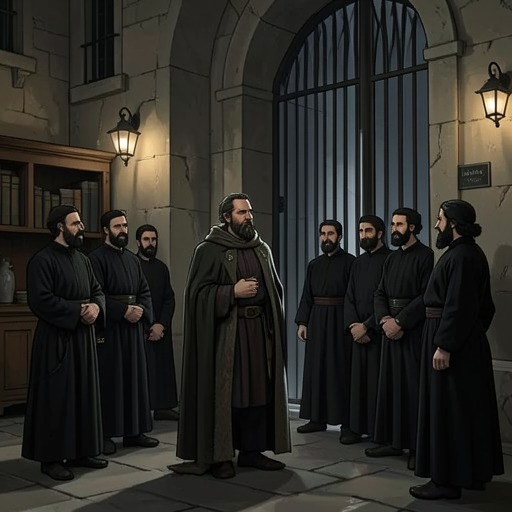
On the evening before Fisher is to die, Cromwell enters More’s cell with a strong guard, leaving the guards in the outer chamber so that he can speak with More alone. More has grown used to sitting in the dimness behind a drawn blind. He receives Cromwell almost cheerfully, but the conversation soon turns to the bishop’s fate. More expects to keep vigil when the guards come for Fisher in the morning. He understands that the king has shown mercy only in the manner of Fisher’s death, on account of his age and frailty; that concession does not spare him execution.
Cromwell reaches across the table and takes More’s hand, gripping it harder than intended. He asks More, when brought before the court, to throw himself on the king’s mercy. Cromwell says Henry is not cruel and may grant More the same consideration as Fisher, even if he will not let him live after refusing the oath. His appeal is personal as well as strategic: Cromwell does not want to see More suffer. Yet the plea also reveals the limit of the government’s offer. Mercy may alter the punishment, but it does not resolve the demand that More submit.
More answers that the body’s fate is not the central issue. He says he has led a blessed life and must not fail God now that his faith is being tested. He admits that he fears pain, but believes it will last only a moment and that God will not let him remember it afterward. Cromwell recognizes the distance between them: More’s mind is fixed on the next world, while Cromwell remains troubled by the possibility of improving this one. Their disagreement is neither abstract nor detached; it is brought into the small, shadowed room by the immediate prospect of Fisher’s death and More’s own trial.
Conscience, Silence, and the Threat of Punishment
The conversation turns on what can be demanded of a person when political and spiritual authority claim the same allegiance. More says he loves England but fears that it will be damned. He will not yield the ground on which he stands, because, as he puts it, that ground is Thomas More. His position makes his refusal more than a tactical silence: he treats the preservation of his conscience as a duty that cannot be transferred to the king or Parliament.
Cromwell sees the same refusal from the perspective of government. He asks More to write out his defence, an offer More declines, saying his defence remains in his mind, beyond Cromwell’s reach. For Cromwell, words and written records are instruments through which the law can be argued and enforced; for More, keeping his reasoning unwritten protects it from being used against him. His silence is therefore active, not empty. It withholds the statement the government needs while preserving the distinction he draws between temporal jurisdiction and spiritual authority.
More’s fear of the execution itself also becomes explicit. He asks Cromwell how a traitor is killed and begs to be killed cleanly if the full penalty is imposed. Cromwell replies that the executioner’s method is kept secret. The exchange exposes a tension in Cromwell’s role: he can encourage More to seek royal mercy, yet he is also part of the system whose penalty More fears. The book does not turn this encounter into a reconciliation. More continues to refuse, and Cromwell cannot offer him a way out that leaves the oath unanswered.
Death, Witness, and Aftermath
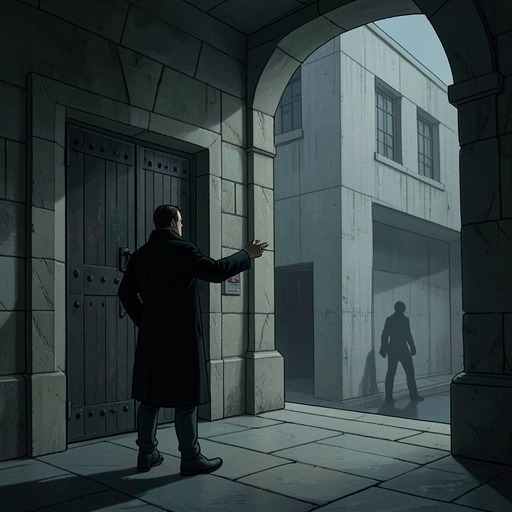
The next time Cromwell sees More is at Westminster Hall. The account pauses over the approach to the trial rather than depicting Fisher’s death as a spectacle. Cromwell says he will be present for the bishop, though not at the instant of death; according to protocol, spectators bow and doff their hats to mark the passing of the soul. Fisher’s execution thus appears through its anticipated ceremony and the conduct it demands of witnesses, while the narrative’s attention remains on More’s impending trial.
After More is sentenced and executed, the narrative returns to the execution landscape through Cromwell’s memory. More is led to the scaffold by Humphrey Monmouth, who serves as Sheriff of London. Cromwell sees More in a rough grey cape, speaking to the headsman, then kneeling at the block in prayer. At the stroke, Cromwell kneels with the other witnesses and makes the sign of the cross. The account does not present this later execution as Fisher’s; rather, it lets More’s death carry forward the pressure established by Fisher’s, linking two opponents of the royal religious settlement without collapsing their distinct fates.
That link is sharpened by the book’s recurring concern with how the dead are remembered. Cromwell reflects that the living can alter the dead’s history, rewriting their lives and even their deaths; he recalls the false report that Thomas More spread about Thomas Bilney recanting at the stake. In this context, Fisher’s death is more than a punishment in the present. It belongs to a contested account of what fidelity, lawful authority, and martyrdom mean, and of who has the power to shape that account afterward.
Narrative Significance
Fisher’s execution is narrated obliquely: first as a death expected the following morning, then as the occasion for Cromwell and More’s private encounter, and finally as part of the pressure that surrounds More’s trial. That structure makes the event’s central force relational rather than procedural. Fisher is absent from the cell, but his fate defines the terms of Cromwell’s warning and More’s answer. The threat of death is already present before the execution itself enters the narrative.
The episode also sets the practical reach of royal authority against the claims it cannot settle by force. Cromwell believes mercy may preserve More’s life, but More distinguishes bodily survival from fidelity to God. Neither man persuades the other; their restrained conversation ends with More’s resolve intact. Fisher’s execution therefore functions as both consequence and warning: it demonstrates what the government can do to a resisting subject, while the narrative’s focus on conscience and memory leaves open the question of whether punishment can determine the meaning of resistance.